Independent Research Lab
Directed by Jim Meuer
Frontier Computing Architectures Using Light, Physics, and Simulation
Exploring new computational paradigms built from optical logic, wavelength-domain control, and physics-native system design.
This research investigates how computation can operate closer to physical principles — enabling new architectures that emphasize parallelism, energy efficiency, and spatial scalability.
These systems are early-stage engineering efforts aimed at expanding what computing can become.
Aloha!
This research explores unconventional computational and physical systems — not by extending existing paradigms, but by rethinking computation from the ground up.
Current work focuses on:
- Optical logic and photonic computing architectures
- Physics-inspired simulation engines
- Agent infrastructure and secure coordination frameworks
- Exploratory models of time, causality, and complex systems
The goal is straightforward and ambitious:
Turn frontier ideas into working technology — even when the path is unclear.
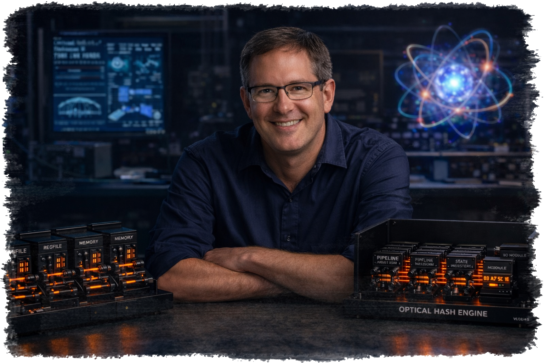
Independent Research in Frontier Computing
This work spans several interconnected domains:
Optical Logic & Photonic Computing
Logic gates, registers, buses, and control systems implemented using light, interference, and wavelength multiplexing rather than electrical wires.
Wavelength-Domain Data Systems
Frequency-encoded control signals, free-space optical buses, and spatially layered signal architectures.
Physics-Based Simulation Platforms
Simulation environments designed to explore physical systems, time navigation, and emergent behavior as investigative tools.
Computation does not need to fight physics — it can use it directly.
Research emphasizes systems that:
- Reduce domain conversions between physical representations
- Exploit inherent parallelism in light and fields
- Scale spatially rather than through transistor density
Why This Matters
Modern computing faces fundamental constraints:
- Power density and thermal limits
- Memory and interconnect bottlenecks
- Diminishing returns from transistor scaling
Physics-native and optical computation offer an alternative path.
By using:
- Interference instead of Boolean switching
- Wavelength instead of voltage
- Spatial structure instead of routing congestion
It becomes possible to build systems that are:
- Massively parallel by design
- Faster at scale
- More energy efficient
These architectures are not replacements for conventional computing — they are complements that enable new classes of computation.
Research Programs
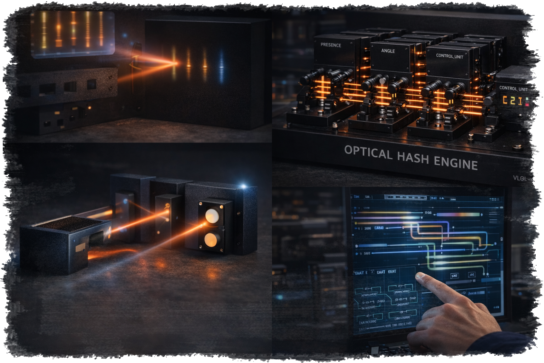
Optical Logic & Computing
A physical logic system built from light.
- In-memory optical tensor processors for inference processing
- Interference-based logic primitives
- Free-space, stacked-lane optical buses
- Wavelength-domain control systems
- Compiler concepts mapping logic to light circuits
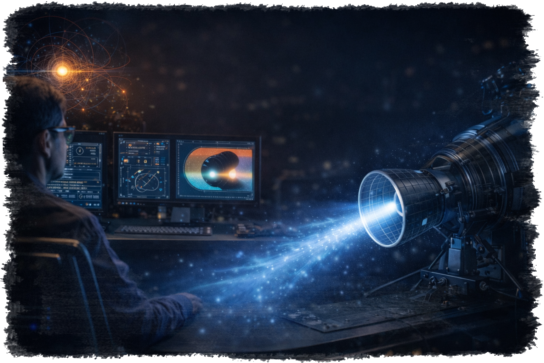
Secure Agent Management Platform (SAM)
Security infrastructure for coordinating autonomous AI systems.
- Identity-centric agent architecture
- Capability sandboxing and policy enforcement
- Verifiable execution environments
- Transparent operational telemetry
Physics-Inspired Propulsion Modeling (Exploratory R&D)
Simulation-first exploration of unconventional physical systems.
- Vacuum-mode structures and boundary effects
- Design-space exploration before physical prototyping
- Focus on measurable sub-experiments

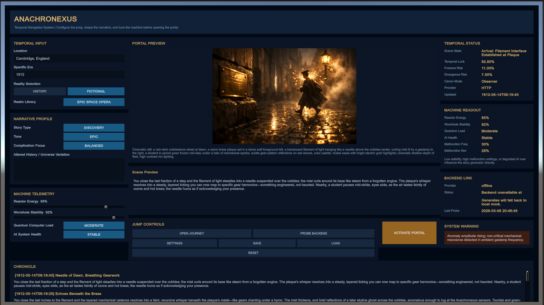
Time & Multiverse Simulation Engine (Anachronexus)
A serious-play environment for exploring time and causality.
- Interactive time-navigation interfaces
- Branching realities and emergent narrative generation
- Emergent narrative simulation

Collaboration
This research welcomes collaboration with individuals and organizations interested in:
- Experimental computing architectures
- Physics-inspired hardware
- Simulation platforms
- Agent infrastructure
- Frontier engineering
Get in Touch
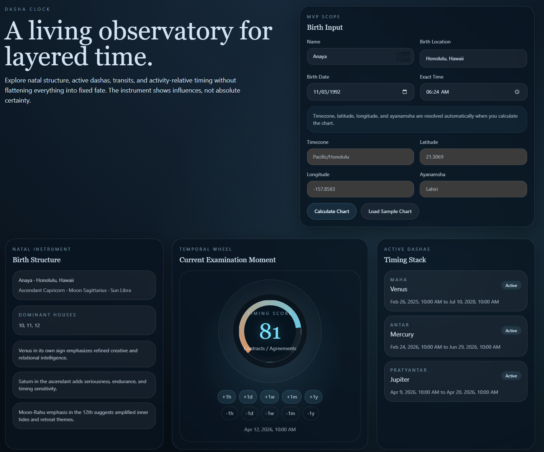
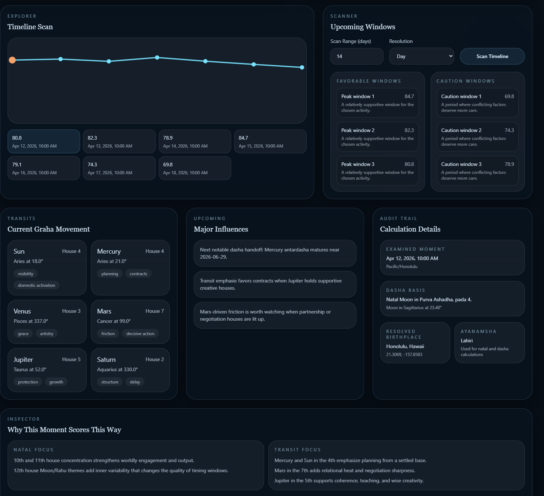
The Dasha Clock
A living observatory for layered time.
- Combines your birth chart, dashas, transits, and fine time cycles into one interactive timing dashboard.
- Shows favorable and cautionary periods for different life areas such as work, relationships, health, travel, creativity, and spiritual practice.
- Lets you move forward or backward through time to spot upcoming opportunities, challenges, and the best windows for specific activities.
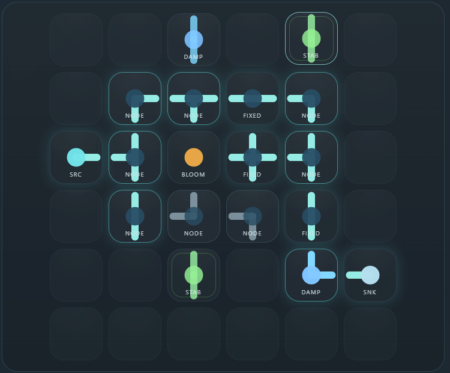
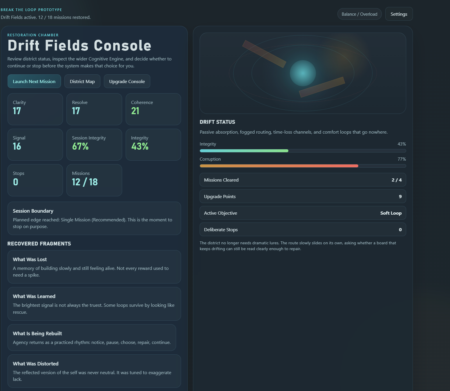
Break the Loop
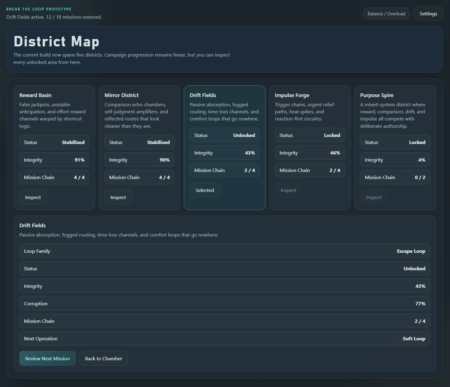
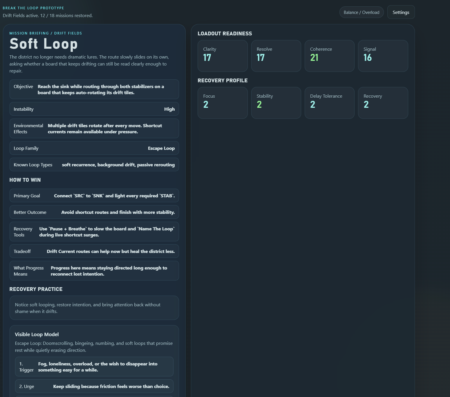
An interactive system for recognizing and interrupting compulsive patterns.
- A sci-fi strategy game about reclaiming control from addictive patterns.
- Transforms addictive cycles such as gaming, scrolling, gambling, and other repetitive behaviors into visible challenges the player can identify, understand, and disrupt.
- Shows how triggers, urges, false rewards, and reinforcing habits build self-sustaining loops that gradually reduce clarity, freedom, and control.
- Lets the player practice breaking patterns, rebuilding stability, and choosing stronger responses that restore agency, awareness, and long-term balance.